Blog Post
How to read a Product Specification
Understanding how to decipher a product specification is a valuable skill for consumers and industry professionals alike. A product specification serves as a comprehensive blueprint, detailing the key attributes, features, and performance criteria of an item. Navigating through the technical language and myriad details can be daunting, but it is an essential step in making informed decisions about purchases or ensuring that industry standards are met.
COMPONENTS
Components of a Product Specification
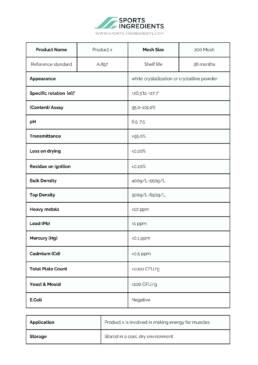

Product name

Mesh Size: Mesh size refers to the number of openings per linear inch in a screening or sieving material. A higher mesh number indicates a greater density of openings, resulting in finer particles being retained. For example, a mesh size of 100 means there are 100 openings per linear inch, allowing the passage of particles smaller than those retained by a mesh size of 50.

Reference standard: Quality standards are established criteria and specifications that products, services, or processes must meet to ensure consistency, reliability, and compliance with industry or regulatory requirements. They serve as benchmarks for assessing and guaranteeing the reliability, safety, and performance of a product or service. Adhering to quality standards helps organizations meet customer expectations, enhance product effectiveness, and maintain a competitive edge in the market.

Shelf life: Shelf life refers to the duration during which a product remains safe for consumption, maintains its intended quality, and meets regulatory standards when stored under specified conditions.

Appearance: The appearance of a product encompasses its visual characteristics, such as color, shape, size, texture, and overall presentation. Examples are white crystallization or crystalline powder.

Specific rotation: The specific rotation, often denoted as [a]D20, is a measure of the optical activity of a chiral substance, such as amino acids, particularly in the context of polarized light. It represents the angle through which plane-polarized light is rotated by a solution of the substance. A positive specific rotation indicates a clockwise rotation of polarized light (dextrorotatory), while a negative specific rotation indicates a counterclockwise rotation (levorotatory).

(Content) Assay: Content assay is a laboratory analysis method used to determine the quantity or concentration of a specific active ingredient or compound in a substance, such as a pharmaceutical drug or dietary supplement. This testing process helps ensure that the product contains the claimed amount of the active substance and meets regulatory or formulation specifications. A high percentage outcome indicates that the concentration of the active ingredient in the tested substance is as expected or greater than expected.

pH: pH is a measure of the acidity or alkalinity of a solution and is expressed on a scale from 0 to 14, with 7 being neutral. A pH below 7 indicates acidity, while a pH above 7 indicates alkalinity. pH is a critical factor in various processes, including chemical reactions, biological functions, and the formulation of products, and it can impact the stability and performance of substances in different environments.

Transmittance: Transmittance is a measure of the amount of light or other electromagnetic radiation that passes through a material. Expressed as a percentage, it indicates the proportion of incident light that successfully travels through the substance without being absorbed or scattered. High transmittance values suggest greater transparency, while low values indicate increased absorption or scattering of light within the material.

Loss on drying: Loss on drying (LOD) provides information about the moisture content in a substance. By measuring the weight loss of a sample before and after drying, LOD quantifies the amount of water or volatile components present. This information is crucial as it helps to assess product stability, quality, and adherence to specified formulation requirements. Mostly, for powders a low LOD is desirable because it indicates that the substance has minimal moisture content.

Residue on ignition: Residue on ignition (ROI) is a laboratory test that measures the amount of inorganic material left behind after the combustion of a substance. It is often used to determine the purity of the product by assessing the presence of non-volatile residues. The residue on ignition is expressed as a percentage, indicating the proportion of the original material that remains as ash after heating. A low ROI suggests that the substance contains minimal inorganic or non-volatile residues, indicating higher purity.

Bulk Density: Bulk density refers to the mass of a material per unit volume, typically expressed as grams per liter (g/L). It is a measure of how closely packed or dense a substance is, providing insights into its physical characteristics, porosity, and packing efficiency. Bulk density is a crucial parameter for quality control, manufacturing processes, and determining storage requirements.

Tap Density: Tap density is a measure of the maximum packing density of a powder or granular material achieved under tapping or vibration. It is determined by tapping a container containing the material until little further volume reduction occurs. Tap density is used to assess the flowability, compaction, and packing efficiency of powders, which can influence manufacturing processes and final product quality.

Heavy metals: Heavy metals, such as lead, mercury, and cadmium, can pose health risks when consumed in excess amounts. Regular testing and monitoring of heavy metal levels in sports nutrition products help maintain product quality, safeguard athlete health, and uphold industry standards, contributing to the overall safety and efficacy of nutritional supplements.

Microbiology: Understanding the microbiology values in sports nutrition products is essential for ensuring product safety and preventing contamination. Microbial contaminants, such as bacteria, yeast, and mold, can compromise the quality of nutritional supplements and pose health risks to athletes. Regular testing for microbiological parameters helps maintain the integrity of sports nutrition products, ensuring they meet high standards for safety and quality control.

Application: The application section provides information on the specific functions and uses of the compound or product. It typically outlines the intended purpose and recommended usage to guide consumers, healthcare professionals, or other end-users.